Why isn’t a name and an email a lead?
Most B2B SaaS teams that have sold for three years or more have plenty of names. What they lack is a reason to contact any particular name this week. When reps work from a list with no timing, they contact the same accounts every month and hope one of them is ready. The fix is a signal layer (the part of a GTM system that watches for events suggesting an account may be starting to buy) plus a short brief that turns each signal into a conversation.
Buyers have also moved further before they talk to you. In 6sense’s 2025 B2B Buyer Experience ReportSource 1 (vendor research, about 4,000 buyer responses), 79% of buyers said they, not the vendor, started the first conversation. First contact came about 61% of the way through their buying journey. A cold, generic message lands late and without context.
In 6sense's 2025 survey, first contact with a seller came about 61% of the way through the buying journey, and 79% of buyers said they started that conversation. Vendor data. Source: 6sense, B2B Buyer Experience Report (2025), about 4,000 buyer responses (opens in a new tab).
Relevance is the part a list can’t give you, and the part a brief is built to supply.
Timing is the other part. The Ehrenberg-Bass Institute’s 95-5 ruleSource 2 (industry data: a 2021 model) holds that “up to 95% of business clients are not in the market for many goods and services at any one time”. In most weeks, most of your market isn’t ready to talk, which is why a brief needs a dated reason.
What goes into a sales-ready lead brief?
A sales-ready lead brief is a one-page summary that tells a rep why an account fits, what just happened there, who to contact and what to say first. It combines fit (does this account look like the customers you win?) with intent (is something happening now?) so the rep can start a relevant conversation without doing the research themselves.
Here are the seven parts, what each one answers, and the test to apply before a brief goes to a rep.
| # | Part | The question it answers | Where the data usually comes from | The test before it ships |
|---|---|---|---|---|
| 1 | Fit score and why | Does this account look like the customers we already win? | Your closed-won history, firmographic and technology data | The rep can name the two or three fit reasons in one sentence |
| 2 | The signal and its date | What happened, and when? | Job changes, hiring, funding, news, first-party engagement | It has a date, and the date is recent enough to matter |
| 3 | Why now | Why does this event make our problem urgent for them? | The rep’s or researcher’s judgement, linked to your product’s pain | It connects the signal to a pain you solve |
| 4 | Who’s involved | Who feels the pain, who decides, who else will have a view? | LinkedIn, the company site, your CRM’s past contacts | At least one named contact and one likely stakeholder |
| 5 | Suggested angle | What’s the one idea to open with? | Your positioning, matched to the signal | It would still make sense if the prospect forwarded it to a colleague |
| 6 | Three first-call questions | What does the rep need to learn on the first call? | SPICED, applied to this account | Each question can only be asked of this account |
| 7 | Previous touches and what to avoid | What has this account already heard from you? | CRM activity, closed-lost notes, marketing email history | Nothing in the angle repeats a message they ignored |
1. Fit score and why
A number on its own doesn’t help a rep. The brief should say why the account scored well, in terms your team recognises, for example: “private healthcare group, 400–900 staff, runs shift rosters on spreadsheets, same profile as four of your last ten wins”. If the fit reasons come from your own closed-won deals rather than a generic persona, reps trust them. That’s why the scoring model should be tested on your own sales history before it scores anything new.
2. The signal and its date
“Hiring” is not a signal. “Posted four scheduler roles on 12 September” is. The date matters because most signals decay: a new leader’s first 90 days tend to be more open to change than their second year. If the brief can’t date the signal, it isn’t one.
3. Why now
It’s the line that makes the brief worth reading, and the easiest one to skip. It links the event to your product’s pain: “Four new schedulers means rostering volume is growing faster than the team that manages it.” If nobody can write this sentence, the account goes back to warming.
4 to 6. People, angle and questions
Name at least two people, because B2B purchases are made by buying groupsSource 1 and a brief with one name has a single point of failure. Keep the angle to one idea that comes from the signal and points at the outcome you deliver. The questions get their own section below.
7. Previous touches and what to avoid
After three years of outbound, many accounts in your market have heard from you before. The brief should say when, from whom and what happened: “Two sequences in 2025, no reply; a lost deal in March 2024 on timing.” That stops the rep from sending the message the account already ignored.
An example sales-ready lead brief
Fictional companies and people, for illustration only. Not a HeyThere client or result.
Seller: a South African SaaS company selling workforce rostering software to healthcare groups.
Account: Olvenhurst Health (fictional), a private healthcare group with about 650 staff across six sites.
- Fit: 88/100. Healthcare group, 400–900 staff, multi-site, rosters built in spreadsheets. Matches the profile of four of the seller’s last ten closed-won deals.
- Signal: 12 September 2026. Olvenhurst posted four “shift scheduler” roles on its careers page. A new Head of Operations joined four weeks earlier.
- Why now: hiring schedulers means roster volume is outgrowing the people who manage it, and a new operations head is still setting priorities for the year.
- Who’s involved: Head of Operations (contact; new in role). Likely stakeholders: the HR manager (owns scheduling staff) and the finance director (approves software spend).
- Suggested angle: “Adding schedulers is one way to handle a bigger roster. The other is to make each scheduler’s week shorter.” Point to a short, relevant example, not a demo request.
- First-call questions:
- Situation: “How are rosters built across the six sites today, and who signs them off?”
- Pain and impact: “When a shift goes unfilled at short notice, what does it cost you, in overtime or agency staff?”
- Critical event: “Is there a date the new schedulers need to be productive by, or a budget cycle this would fall into?”
- Previous touches: one email sequence in May 2025 to the former operations manager (no reply). Don’t reuse the “digital transformation” subject line. No open or lost deals.
Intent: 74/100 · Brief refreshed 16 September 2026 · Expires if no new signal by 16 October 2026.
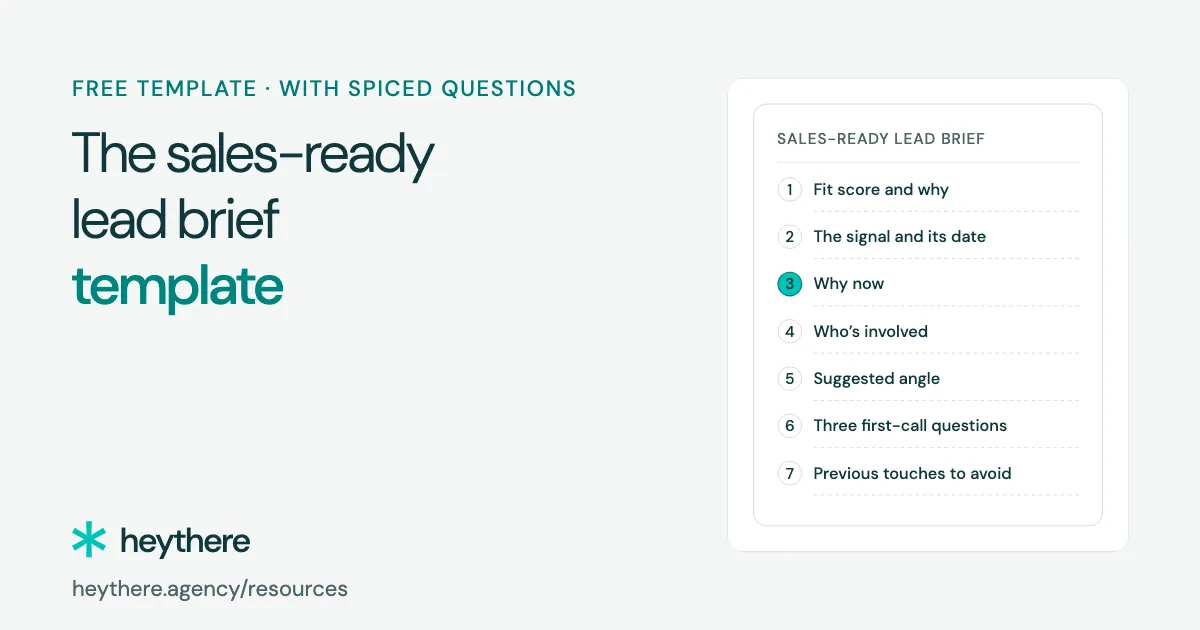
Seven parts on one screen, numbered as in the table above. Part 3, why now, is the line a person checks before anything is sent. Example data: Olvenhurst Health is fictional. About this data: Olvenhurst Health (fictional), for illustration only.
Anatomy of a sales-ready lead brief, as text:
- Fit score and why
- The signal and its date
- Why now
- Who's involved
- Suggested angle
- Three first-call questions
- Previous touches and what to avoid
Notice what the brief doesn’t contain: a company history, a list of every news item, or the prospect’s full career. Reps don’t need more research. They need the three or four facts that make the first message relevant.
Download the sales-ready lead brief template. A fill-in version of the seven parts, with a SPICED question bank and a pre-send checklist, plus the Olvenhurst Health example filled in. Download the lead brief template
How do signals change the brief? The same account, in two different weeks
The same account can be a poor lead one week and a good one the next. Nothing about its fit changes. What changes is whether something is happening.
| Week of 4 August 2026 | Week of 15 September 2026 | |
|---|---|---|
| Fit | 88/100 | 88/100 |
| Signals | None in the last 90 days | New Head of Operations (about 4 weeks ago); four scheduler roles posted (12 September) |
| Intent | 21/100 | 74/100 |
| Decision | Keep in warming: marketing content only, no rep outreach | Write the brief; rep contacts the Head of Operations this week |
| What the rep would have said | A generic introduction, like the one ignored in 2025 | An angle about roster growth, with questions about the new schedulers |
Example data: Olvenhurst Health is fictional.
Olvenhurst's fit stays at 88. Two dated signals move intent from 21 to 74, and the brief is live until 16 October. Example data: Olvenhurst Health is fictional. About this data: Olvenhurst Health (fictional), for illustration only.
The decision rule is simple:
- Fit and a signal: write the brief and contact the account.
- Fit, no signal: keep it in warming (useful content, events, marketing), and don’t send a rep.
- Signal, poor fit: ignore it, however loud it is.
- Neither: remove it from this quarter’s list.
This is also why a lead brief expires. A brief built on a dated signal lets your reps spend their effort on the few accounts that might be ready, and keeps the rest warm without annoying them.
Which first-call questions belong in a brief?
The questions are where the brief turns into a conversation. This template builds them on Winning by Design’s SPICED framework (Situation, Pain, Impact, Critical event, Decision), a discovery framework many B2B sales teams already use. HeyThere isn’t affiliated with Winning by Design. The framework is used here because it gives reps a shared checklist for what to learn.
Three questions are enough for a first call. Choose the three letters where the brief is weakest:
| If the brief is unsure about… | Ask a question about… | Example (for Olvenhurst Health) |
|---|---|---|
| How they work today | Situation | “How are rosters built across the six sites today?” |
| Whether the problem hurts | Pain | “Where does rostering take the most time for your team?” |
| What the problem costs | Impact | “What does a short-notice unfilled shift cost you?” |
| Whether there’s a deadline | Critical event | “Is there a date the new schedulers need to be productive by?” |
| How they’d buy | Decision | “Who else would want a say in how rostering changes?” |
A good first-call question has two properties: the rep can only ask it of this account, and the answer changes what happens next. “What are your priorities this year?” fails both tests.
How does a rep use the brief on the first call?
- Read the why-now line first. If it no longer holds (the roles were filled, the leader left), don’t send anything. Flag the brief as stale.
- Check the previous touches. Make sure the message doesn’t repeat anything the account ignored.
- Open with the angle, not the product. One or two sentences that show you noticed the signal and understand what it means for them.
- Ask for a short conversation, not a demo. The goal of the first call is to test the why-now, using the three questions.
- Log the answers against SPICED fields in your CRM. The next brief for this account, and the next person who picks it up, starts from what the rep learned.
- Close the loop. Mark whether the signal led to a conversation. Over a quarter, this tells you which signals are worth tracking for your market.
Step 6 matters more than it looks. The signals that precede real conversations in your market won’t be the same as a vendor’s generic list, and the only place to learn them is your own CRM.
Read the why-now line first, and close the loop last, so the team learns which signals lead to conversations.
Six steps on the first call, as text:
- Read the why-now line first.
- Check the previous touches.
- Open with the angle, not the product.
- Ask for a short conversation, not a demo.
- Log the answers against SPICED fields in your CRM.
- Close the loop.
Should you write lead briefs by hand or with a workflow?
Time is the constraint. In Salesforce’s State of Sales reportSource 3 (industry data; 4,050 sales professionals in 22 countries), the average seller spent 40% of their time selling. The same survey found sellers expect AI agents to cut prospect research time by 34%. That’s an expectation, not a measured saving, but it shows where reps feel the drag.
| By hand (rep or SDR) | Workflow (enrichment and research automation, checked by a person) | |
|---|---|---|
| Good for | Up to about 10 accounts a week; testing which parts of the brief your reps use | Every fit account in the market, re-checked whenever a signal changes |
| Consistency | Varies by rep | Same seven parts every time |
| Freshness | Written once, rarely updated | Refreshed when a signal fires or expires |
| Main risk | Research time comes out of selling time | Confident-sounding summaries that are wrong, or angles that read as automated |
| What it needs | A template and discipline | Clean fit criteria, signal sources, CRM fields for each part, and a human check on “why now” |
Workflow tools can now write research straight into CRM fields. Clay, for example, documents account research agentsSource 4 that combine CRM data, call transcripts and signals into fields on each account (vendor documentation). Whatever tool you use, keep one rule: a person reads the why-now line before a rep acts on it. A wrong “why now” is worse than none, because it tells the prospect you didn’t look.
When is a lead brief not worth the effort?
- Very high-volume, low-value sales. If a deal is worth less than the time a brief takes, use segments and templates instead.
- No signal source for your market. If nothing observable happens before your buyers buy, briefs will be fit-only, and you should put the effort into warming.
- A CRM you can’t trust yet. Parts 1 and 7 depend on clean win and activity history. If that’s in doubt, start with a GTM data audit.
- Founder-only selling. A founder with a short list usually holds the brief in their head. Briefs pay off when several reps share a market.
Free template
The sales-ready lead brief template
The seven-part brief from this guide as a blank template, with a SPICED question bank, a pre-send checklist and a completed example.
- Free · PDF or Word · email only